



What you will see in this article
- A holding deposit and a deposit are not the same thing
- What to sign: the minimum that protects both buyer and seller
- What NOT to sign as is
- The deposit: how much makes sense and how to pay it
- New build: the reservation isn’t “less serious”, it’s different
- If you are not a resident: what to check before setting dates
- Warning signs that are worth taking seriously
- Costs and expenses when buying a property in Andorra
- Next step: prepare a secure signature
- Frequently asked questions
In a property purchase, the holding deposit or deposit is the moment when everything stops being mere “interest” and becomes a commitment. And that is why it is the point where the most people make mistakes: it is signed in a rush, a deposit is handed over without tying down conditions and, when an unforeseen event arises (financing, documentation, deadlines, permits), the problem is no longer the flat: it is the paperwork that was signed.
In Andorra it is usual to formalise this commitment with a reservation contract (very common for off-plan property) or a deposit contract, signed between the parties without the need for a notary at that initial stage.
This article helps you to identify what needs to be put in writing, which clauses are negotiable, which warning signs are worth taking seriously and, above all, what NOT to sign just as it is put in front of you. If you are looking for a home, you can start by checking all available properties or filtering by typology like flats and apartments o penthouses. If you already have a property in mind and want to proceed methodically, the process can be conducted from the shopping service and, when appropriate, reinforce with the property verification.
A reservation fee and a deposit are not the same thing (and it is best if the paperwork says so)
In practice, the reservation is usually used to “lock in” a property for a short period while documents are prepared or conditions are finalised (especially in developments).
The deposit, on the other hand, is usually a more comprehensive agreement: it sets the price, deadlines and consequences if one party pulls out.
The important thing is not the name of the document, but what it contains: there are “reservas” that act as a deposit and “arras” drafted as a simple token payment with no real protection.
What to sign: the “minimum” that protects buyer and seller
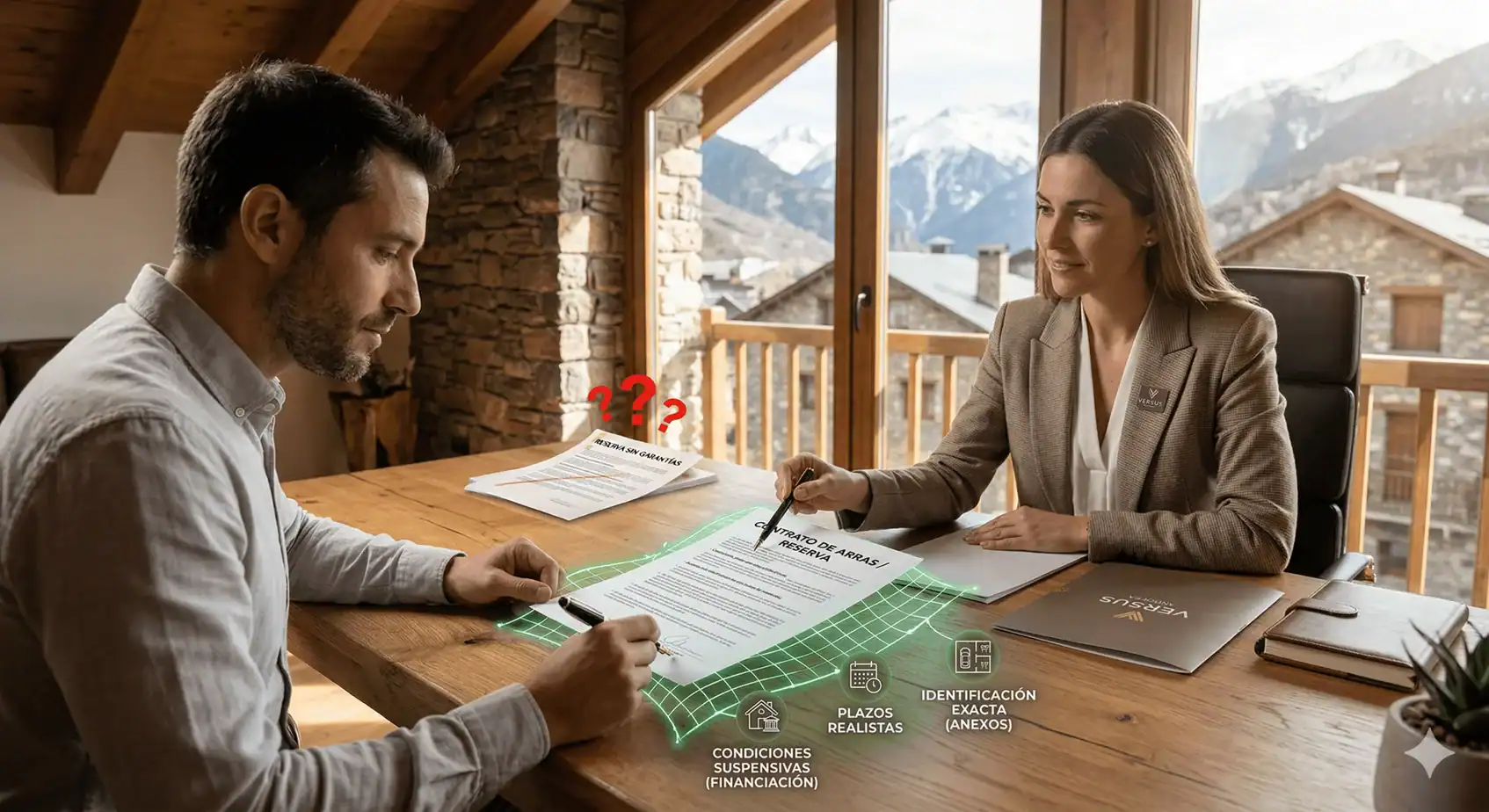
If the document is well formulated, it should contain at least:
Minimum clauses of a reservation/deposit contract
- Exact identification of the property and annexes: full address, and if it includes a parking space, storeroom or other annexes, they must appear explicitly. What is not written down, is argued about later.
- Total price and payment method with schedule: it is not enough to say “price X”; it is advisable to make clear when what is paid, and which payments are deducted from the final price.
- Realistic deadlines, with dates and consequences: deadline for signing at the notary's office (or for executing a public deed if applicable), and what happens if there is a delay due to a justifiable cause. Ambiguity here is the mother of all conflicts.
- Conditions precedent (the difference between security and signal loss). In residential properties, the most common are:
- grant of finance (if subject to a mortgage)
- obtaining documentation or satisfactory verification
- and, in some cases, administrative authorisations if applicable to the buyer's profile
- What happens if a party withdraws (penalty, refund, deadlines). This must be clearly defined, without open-ended phrases such as “at the discretion of the parties”.
What NOT to sign as is (and why it usually costs you dear)
There are three typical situations where it is advisable to stop:
If the document says that the signal is lost “come what may”, you are assuming all the risk. In that case, either a suspensive condition must be introduced, or the refund scenario must be redefined.
If there are no dates, there is no control. If the dates are not realistic (due to documentation, permits or coordination), there is tension from day one.
Phrases like “sold as seen” without attachments, without inventory (if applicable) and without the option of verification, leave the buyer without recourse if something relevant turns up.
This is usually where it fits to ask for a property verification before paying the deposit, especially if you are not familiar with the building, its actual condition or the paperwork.
The deposit: how much makes sense and how to pay without overexposing yourself
There is no single “official” percentage, but in practice, figures are typically in line with market norms (sometimes around 10%), depending on whether the property is off-plan, a deposit, a new-build or a resale.
What matters is not the number, but that it is made clear:
- if that deposit is deducted from the final price
- in which cases is it refunded
- and what documentation/conditions protect it
If payment is made without the document being finalised, the buyer immediately loses negotiating power.
In Andorra, the reservation contract deposit is usually between 3,000 and 10,000 euros. If the buyer pulls out, they lose the deposit. If the vendor pulls out, they must return double the amount. Reviewing all resolutory conditions before signing is essential.
New build: the reservation isn’t “less serious”, it’s different
For new-build property, the reservation contract is widely used to secure a specific unit and fix specifications.
In these cases, in addition to the above, it is especially important to collect:
New-build specific clauses
- Floor plan / specification of qualities (or unambiguous reference)
- Delivery dates and late penalties (if agreed)
- How changes or modifications are managed
If you are exploring promotions, you can compare offers in the inventory of all properties and, when it is in the decision phase, channel it from the shopping service to organise paperwork and deadlines.
If the buyer is a non-resident: what is best to check before setting dates
In Andorra, there are specific obligations regarding foreign real estate investment (including a tax regulated by law), and this may affect the planning of the transaction depending on the case.
The practical point is not memorising regulations: it is avoiding signing a deposit agreement with a notary date that is impossible for your situation. To consult current legislation and consolidated texts, the official reference is the Legal Portal of the Principality of Andorra.
An approach that usually works: clear commitment, but with a safety net. That “net” usually takes the form of a financing condition precedent (where applicable), a satisfactory verification/documentation option, realistic timeframes, and defined consequences if things go wrong. If the document does not allow for that net, you are agreeing to a blind transaction.
Warning signs that are worth taking seriously
- They are asking you to pay a deposit before sending the complete document
- The document does not correctly identify the property or the annexes (parking/storage room)
- There are no dates, or they are “approximate”
- It is not defined what happens if financing is refused or a significant issue arises
- They pressure you with “there's another interested party” so you sign without reading
In these cases, the most professional approach is to stop, review and, if appropriate, go through a property verification before committing money.
Costs and expenses when buying a property in Andorra
Before deciding, it is essential to know all the costs involved in the purchase. Here is a rough summary:
| Concept | Indicative amount | Who pays for it |
|---|---|---|
| Stamp Duty (second-hand) | 4% of the purchase price | Buyer |
| VAT (new build) | 4.5% of the purchase price | Buyer |
| Notary public | 0.5%–1% of the price | Buyer |
| Land Registry | 0.2%–0.5% of the price | Buyer |
| Estate agent fees | 3%–5% of the price | Salesman |
| Foreign investment authorisation | ~600 € | Non-resident buyer |
Approximate costs. They may vary depending on the notary and the final price stated in the deeds.
Next step: prepare a secure signature (no delays or surprises)
To move forward in an orderly fashion, the most useful approach is to work with three pieces of data: the chosen property, the target timeframe, and the critical condition (financing, checks, permits). With that basis, a meaningful reservation/deposit agreement can be structured and the path towards the notary coordinated from the shopping service. The entry point for reviewing it as a team is the contact form.
Continue reading
Frequently asked questions about booking and deposits in Andorra
What is the difference between a reservation and a deposit (arras) in Andorra?
The holding deposit is usually used to block a property for a short period while documents are being prepared, especially for new-build properties. The deposit with earnest money is a more comprehensive agreement that sets the price, deadlines and consequences if one party backs out. What is decisive is not the name, but the content of the document.
How much deposit is paid in a reservation or earnest money contract in Andorra?
There is no fixed official percentage, but in practice reservation deposits usually range from 3,000 to 10,000 euros, and the deposit sometimes amounts to 10% of the price. The important thing is that the document specifies whether it is deducted from the final price and in which cases it is refunded.
What happens if the buyer or the seller backs out after signing a deposit contract (arras) in Andorra?
Usually, if the buyer pulls out, they lose the deposit paid. If it is the seller who withdraws, they must return double that amount. That is why it is essential to review all the resolutory conditions of the contract before signing.