



First Steps on Arrival in Andorra: Correct Sequence by Profile
What you will see in this article
- Before you begin: what you need sorted from your home country
- Step 1 — Registration on the census at your parish council
- Step 2 — Andorran Identity Number (NIA)
- Step 3 — Bank account opening
- Step 4 — Affiliation to CASS or private health insurance
- Step 5 — Permanent residence permit
- The sequence according to your profile: three different cases
- The actual costs of the first 60 days
- The next step
- Frequently asked questions
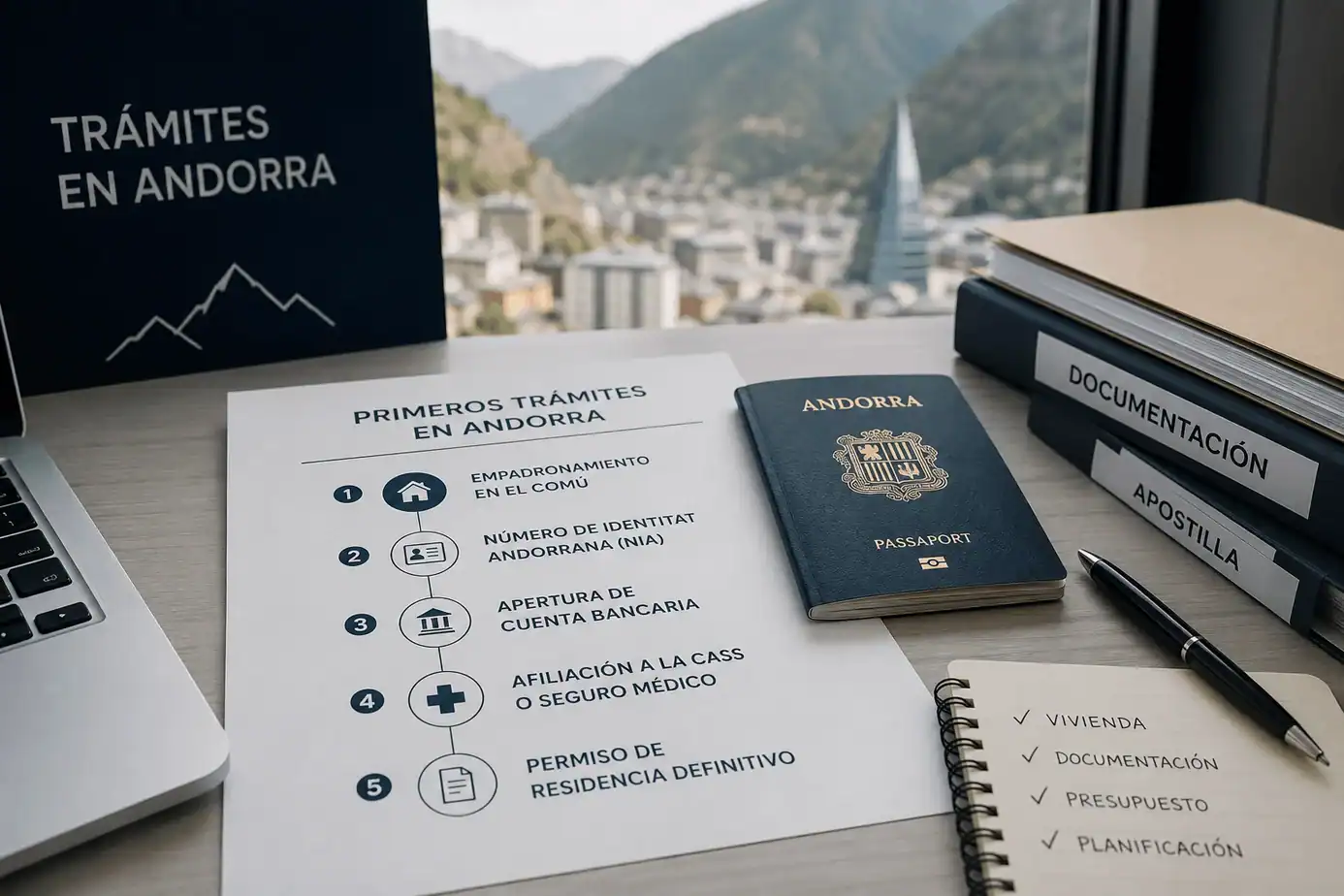
The problem isn't the number of procedures when arriving in Andorra. It's that nobody tells you in what order to do them, and in Andorra order matters more than in almost any other European country. Doing a step ahead of time doesn't speed up the process: it blocks it. Opening a bank account before having the Andorran ID number, for example, is the most frequent mistake among newcomers — and the one that takes the most weeks to recover from.
What follows is the actual sequence of the first procedures in Andorra for a newcomer, with indicative timeframes and the points where almost everyone gets stuck.
Before you begin: what you need to have sorted from your home country
Arriving in Andorra without these two items does not prevent you from starting the paperwork, but it slows it down significantly:
- Property with signed contract. Empadronamiento — the obligatory first step in the sequence — requires a tenancy agreement or title deeds in your name. Without that, the process cannot get off the ground. If you are still looking for accommodation, the rental service allows options to be filtered before physically arriving in the Principality.
- Apostilled documentation if you are coming from outside the EU. Any document issued outside Andorra that you are going to present to the Andorran administration must be apostilled according to the Hague Convention. Managing apostilles from Andorra is possible, but slower and more expensive than doing it before leaving.
The correct sequence: five steps in order
Step 1 — Registration on the census at your parish council
It is the starting point for everything else. Without census registration, there is no legal basis to initiate any other procedure in Andorra.
Registration on the census is done in person at the Comú of the parish where you reside. You will need your rental contract or title deed, a valid passport and, depending on the parish, a recent photograph.
The resolution period is usually immediate or one to three working days. Each Comú has its own opening hours; it is best to check them directly on the Government of Andorra before you set off.
Attempting to register on the electoral roll at an address where one does not actually reside. The local councils verify the correspondence between the submitted contract and the declared address, and any inconsistencies generate case files that delay the whole process.
Step 2 — Andorran Identity Number (NIA)
The NIA is the Andorran equivalent of the Spanish NIE or the tax number of any European country. It is the identifier that links the new resident to the administration, social security and the banking system of the Principality.
It is requested before the Immigration Department of the Government of Andorra, in person, with the certificate of empadronamiento already in hand. Without that certificate from the previous step, the NIA application cannot be processed.
The processing time ranges between one and three weeks depending on the volume of applications and the complexity of the case.
The NIA is not the same as the residence permit. It is an identification number that is assigned when starting the process, whereas the residence permit is the final decision authorising legal stay in the Principality. Confusing them leads to misunderstandings about the rights granted by each document at each phase of the process.
Step 3 — Bank account opening
With the NIA in hand, the process of opening a bank account in Andorra is notably smoother than without it. Andorran institutions — Crèdit Andorrà, MoraBanc, Andbank — require the NIA as a local tax identification document for any resident account opening.
Without the NIE, the same entities can open non-resident accounts, but with more restrictive conditions, greater documentation on the source of funds and without access to certain financial products linked to residency.
Some institutions also request a bank reference letter from the country of origin. It is advisable to request this from your usual bank before leaving, rather than once you have settled in Andorra, where the process is prolonged due to remote administration.
Step 4 — Affiliation to CASS or private health insurance
La Caixa Andorrana de Seguretat Social (CASS) is the social security system of the Principality. Registration is compulsory for employees from the first day of their contract. For the self-employed and passive residents, cover can be arranged through the CASS or via private insurance that meets the minimum requirements demanded by Immigration.
CASS affiliation is usually handled by the employer in the case of employees. For the self-employed, the process is carried out directly with the institution itself, using the NIA and the economic activity registration documentation.
Assume that the private health insurance taken out in the country of origin covers the situation of being a resident in Andorra. The coverage of foreign insurance in Andorran territory has specific limitations that should be verified with the insurer before relying on that coverage.
Step 5 — Permanent residence permit
The residence permit decision closes the sequence. Depending on the type of residence requested — active employment, active self-employment, or passive investment — the requirements and timeframes vary significantly.
For passive residency linked to real estate investment, the minimum threshold is €800,000 in unencumbered real estate investment, according to the criteria published by the Immigration Department of the Government of Andorra. This type of residency has a specific sequence of procedures that is worth planning before finalising the purchase of the property.
The processing time for the residence permit ranges between one and three months depending on the type and completeness of the submitted file.
The sequence varies according to your profile: three distinct cases
Employee
The hiring company manages part of the process (affiliation with the CASS, employment contract as proof of address for registration on the municipal census). The standard sequence applies without modifications, and the employer usually provides support during the initial steps. The main risk is arriving without secured housing and wasting the first weeks looking for accommodation from within the country.
Self-employed or business owner
The sequence gets complicated because the registration of economic activity with the CCIS — Chamber of Commerce, Industry and Services of Andorra it must be coordinated with the immigration process. Starting the activity before having the appropriate residence permit creates legal inconsistencies that can affect both the residence application and the tax status.
Investor or passive resident
The purchase of the property must be planned before starting the residency application file, not after. The property is part of the documentation that supports the application, and its legal status—free of encumbrances, with valid habitability, and ownership without registry issues—directly affects the resolution of the file. The article about passive residence in Andorra through real estate investment detail the specific filters that the property must meet before submitting the application.
What nobody mentions: the real costs of the first 60 days
The first two months in Andorra are concentrated with setup costs that rarely appear in any guide:
- Tenancy deposit: usually two months' rent plus the first one in advance
- Administrative fees concerning residence procedures: varying according to the type of permit
- Bank account opening: some institutions require an initial minimum deposit
- Private medical insurance whilst the CASS affiliation is being sorted: variable cost depending on cover and age
- Translation and apostille of documents: between €300 and €1,200 depending on the document volume and the country of origin
Having this budget calculated beforehand avoids cash flow issues during the most critical phase of the installation process.
The next step
With the residency profile clearly defined — employee, self-employed or passive investor — and the expected date of arrival, the team at Versus Andorra consultancy you can advise on the specific sequence applicable to each case and filter the housing options that fit the real budget for the first few months in the Principality.
Please indicate your profile (employee, self-employed or investor) + expected arrival date + housing budget, and receive the sequence of procedures and accommodation options tailored to your case.
Request bespoke guidance →Frequently asked questions about initial procedures upon arriving in Andorra
What is the first procedure you need to do upon arriving in Andorra?
Registration at the Comú of the parish of residence. It is the legal basis on which all other procedures depend, including the NIA, the bank account and the residence permit.
How long do the initial procedures take in Andorra?
Registration on the municipal register is usually sorted in one to three working days, the NIA between one and three weeks, and the final residence permit between one and three months. The complete sequence, well organised, can be finished in around two to three months from arrival.
Can you open a bank account in Andorra without a NIA?
Yes, as a non-resident account, but with more restrictive conditions, greater documentation regarding the origin of funds and without access to certain financial products linked to residency. With the NIE in hand, the process of opening an account as a resident is noticeably quicker.