



What you will see in this article
Investing in bricks and mortar in the Principality has always been a safe haven, but the smart investor is no longer satisfied with gross yield. The question is not how much money comes in from rent each month, but how much is left in your account after passing through the filter of community fees, insurance and local taxation.
Calculating rental yields in Andorra requires moving away from commercial brochures and getting down to operational detail. The Andorran market offers enviable stability and a demand that far outweighs supply, but for the business to be a complete success, you have to know how to subtract before you add.
Gross yield vs net yield: the real formula
The most common mistake is dividing the annual income by the purchase price. That figure is an illusion. To get the net yield—the one that actually matters—you have to apply this formula:
Net yield (%) = [(Annual income − Operating expenses) / Total investment (purchase + expenses + renovations)] × 100
The total investment must include the cost of taxes and purchase expenses, which usually hovers around 4,5% of the property value. Ignoring this percentage in the initial calculation is starting with a margin of error that will weigh down your return for the first few years.
Expenses you should keep on your radar
For rental profitability in Andorra to be sustainable, your budget must account for these cash outflows:
Operating expenses to be deducted from gross profit
- Service charges: In Andorra, especially in buildings with central heating services or common area maintenance, this expense can vary significantly. It is vital to check the minutes before buying.
- IGIC (General Indirect Andorran Tax) If you rent the property for commercial use or as a tourist accommodation, you must manage the corresponding IGI (generally 4,5%). You can consult the technical details of this tax in the Department of Taxes and Borders of the Government of Andorra.
- Rent default and multi-risk insurance: In a market with rising rental prices, protecting the rent is an investment, not an expense.
- Technical maintenance: Properties in mountain areas suffer from greater wear and tear due to the weather. Setting aside 1% annually for unforeseen expenses is the best way to avoid nasty surprises.
Estimated gross rental yield by parish
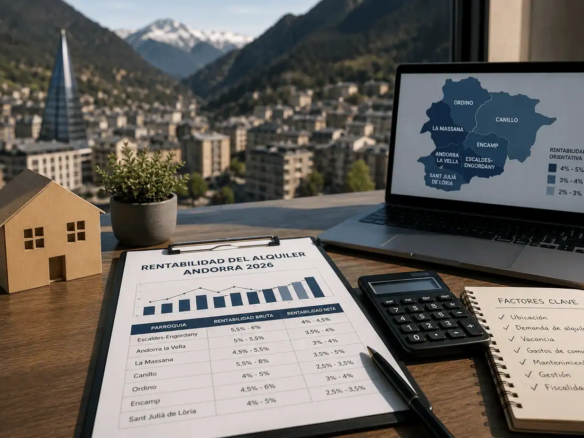
Rental profitability varies significantly by parish. These are the indicative figures for an 80 m² flat:
| Parish | Average price per m² | Average rent/month | Est. gross yield. |
|---|---|---|---|
| Sant Julià de Lòria | 4.100 € | 1.050 € | ~4,5% |
| Encamp | 4.200 € | 1.000 € | ~4,3% |
| Ordino | 3.800 € | 900 € | ~4,2% |
| Canillo | 3.900 € | 950 € | ~4,2% |
| La Massana | 4.800 € | 1.200 € | ~3,9% |
| Andorra la Vella | 5.200 € | 1.400 € | ~3,8% |
| Escaldes-Engordany | 7.400 € | 1.500 € | ~3,4% |
Estimated gross rental yield for an 80 m² flat. Does not include expenses or void periods.
Areas with the highest potential for return
If you are looking for volume and security, the next step is to look towards the centre. The properties in the parish of Andorra la Vella and at the heart of Escaldes-Engordany they maintain the highest occupancy rates in the country. Here, the risk of a void is virtually non-existent.
However, for those seeking more aggressive yields through long-term residential renting, areas such as Encamp or Sant Julià de Lòria offer lower entry prices, which often results in a higher net return than central luxury properties.
The legal context: security for the landlord
Unlike other European countries, the Andorran legal framework is robust and protects private property. Nevertheless, it is advisable to keep up to date with updates to the Department of Statistics of the Government of Andorra, where the CPI variations that you can legally pass on in tenancy agreements are reflected.
To ensure that property management doesn't turn into a second job, the ideal solution is to have professional administration. This not only frees you from managing maintenance issues, but also ensures that tenant selection is carried out under strict solvency criteria.
Is it worth investing today?
The technical answer is yes, provided the purchase is made sensibly. Asset appreciation in Andorra has been steady over the last decade, which adds a “silent return” (capital growth) to the monthly rental cash flow.
The next step
If you need us to audit a transaction you have in mind or want to know which areas are offering the best numbers today, you can consult our team of specialists. At Versus Andorra, we move away from promises of magical returns to offer you a real estate investment advisory service based on real market data.
Recommended next step: to fine-tune your investment budget, it is essential that you know in detail what costs you will have when buying or selling in the country.
Frequently asked questions about rental profitability in Andorra
How is the net rental yield calculated in Andorra?
By subtracting the operating expenses (community fees, IGI if applicable, insurance, maintenance) from the annual income and dividing the result by the total investment, which includes the purchase price, taxes and purchase costs, and renovations if there were any. That percentage, not the gross yield, is what reflects the actual return.
Which parish in Andorra has the best gross rental yield?
According to indicative figures per square metre, Sant Julià de Lòria, Encamp, Ordino and Canillo offer the highest estimated gross yields (around 4.2%–4.5%), compared with 3.4%–3.9% in Escaldes-Engordany or Andorra la Vella, where the purchase price is higher.
What expenses need to be deducted from the gross rental yield in Andorra?
There are four main ones: service charges, VAT if the property is let for commercial or tourist purposes, rent default and comprehensive insurance, and a provision for technical maintenance (roughly 1% per annum of the property’s value) to cover unforeseen events typical of a mountain climate.