



What you will see in this article
Finding an interested buyer is a big step, but the sale is not closed in your living room, but at a notary's table. In the Principality, the administrative phase can be smooth if done right, or a maze if you are missing a single piece of paper on the day of signing.
If you have decided to sell your house in Andorra, the next logical step is to organise your “legal folder”. Having the documents for selling a house in Andorra prepared in advance not only speeds up the process, but also conveys an image of reliability that reassures the buyer and prevents the transaction from stalling.
Personal documentation and property
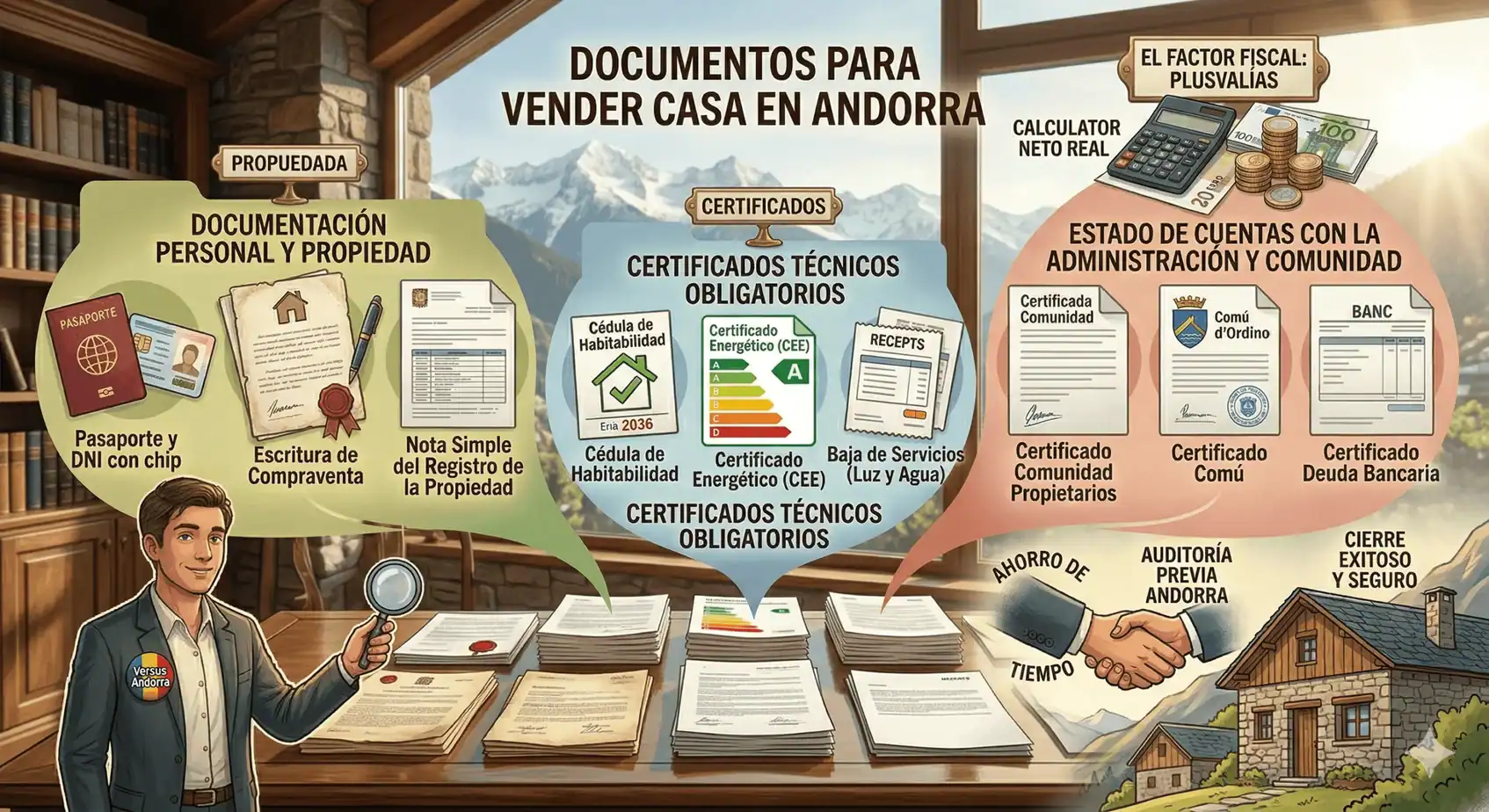
Before getting into technical certificates, the basics must be in order. The notary will need to fully identify the parties and the legal status of the property:
Identification and ownership
- Official ID: Valid passport or ID card of all owners. If you are acting through a company, you will need the power of attorney and the deed of incorporation.
- Deed of sale (title deed): the original document you signed when you bought the property.
- Simple Land Registry extract: it is essential for proving that the property is free of charges or for identifying any outstanding mortgages that must be discharged at the time of sale.
Mandatory technical certificates in Andorra
This is where delays usually occur. Some of these documents have an expiry date or require a visit from a professional:
Technical certificates to prepare
- Certificate of habitability it is the document that certifies that the home meets the minimum health and hygiene conditions. If it has expired (they usually last 10 years), you will need to apply for a new one through an architect or accredited technician.
- Energy Performance Certificate (EPC): mandatory for any transaction. It indicates the property's energy consumption and emissions, a figure that modern buyers value increasingly before buy a property in the country.
- Certificate of service cancellation: Although it's not always handed over on day one, it's a good idea to have the latest electricity and water bills ready to make the change of ownership easier.
The statement of accounts with the administration and the community
Andorra is strict regarding outstanding debts prior to a transfer. To proceed, you will need:
Certificates of tax compliance
- Owners' association certificate: a document signed by the administrator or the secretary confirming that you are up to date with all payments and levies. Selling a flat with community debts is one of the main red flags that block earnest money deposits.
- Comú Certificate: you must prove that you have no outstanding debts with the municipality where the property is located (rates for sanitation, street lighting, etc.).
- Certificate of bank debt (if there is a mortgage): If you are still paying off the loan, the bank must issue a certificate of outstanding debt so that the notary can withhold that amount and pay off the mortgage on the day of signing.
The tax factor: Capital Gains Tax
For the transaction to be transparent, it is advisable that you have previously carried out a technical valuation of your property. Why? Because the Government of Andorra applies a tax on property capital gains that varies depending on the number of years you have owned the property.
You can check the current tax brackets in the Legal Portal of the Principality of Andorra, detailing how the Capital Gains Tax Act affects transfers of property. Knowing this information will help you calculate the actual net profit after the sale.
Required documentation: summary table
The Andorran notary requires this documentation before formalising the sale:
| Document | Who issues it | usual validity |
|---|---|---|
| Original title deed | Notary / Land Registry | Does not expire |
| Certificate of habitability | Parish council | 10 years |
| Energy Performance Certificate (EPC) | Certified technician | 10 years |
| Certificate of community debts | Property manager | 3 months |
| Certificate of good standing from the Comú | Parish council | Current exercise |
| Simple land registry extract | Land Registry of Andorra | 3 months |
Standard documentation for the sale. The notary may require additional documents depending on the case.
Where to start?
Organising all these documents to sell a house in Andorra can seem overwhelming if you do it alone. The most common mistake is waiting until you have a buyer to start requesting certificates.
To avoid this stress, our advice is to carry out a preliminary audit. At Versus Andorra, as part of our sales management service, we make sure your file is complete well before reaching the notary's office. That way, when the ideal buyer appears, the transition is immediate and secure.
Quick seller checklist
- Do I have the original handwritten deed?
- Is my habitation certificate still valid?
- Have I spoken to the property manager about the community certificate?
- Do I know the expenses and taxes that I am liable to pay?
If you have any doubts about a specific procedure or need help processing these documents, you can contact our team of specialists. We will be happy to help you make the sale of your home a stress-free experience.
Frequently asked questions about documents for selling a house in Andorra
What are the essential documents for selling a house in Andorra?
At the very least: identification of the owners, the original title deed, the simple information note from the Land Registry, the current certificate of habitability, the energy performance certificate (EPC) and the certificate of being up to date with community payments and with the Comú.
How long is the certificate of habitability valid for in Andorra?
Usually 10 years. If it has expired at the time of the sale, a new one must be requested through an architect or certified technician before the deeds can be signed before a notary.
Can you sell a house in Andorra with outstanding community fees?
It is one of the main red flags that blocks the deposit or delays the signing. The usual practice is to settle the debt before the sale or deduct it from the price with the express consent of the buyer, which must always be reflected in the community certificate.